
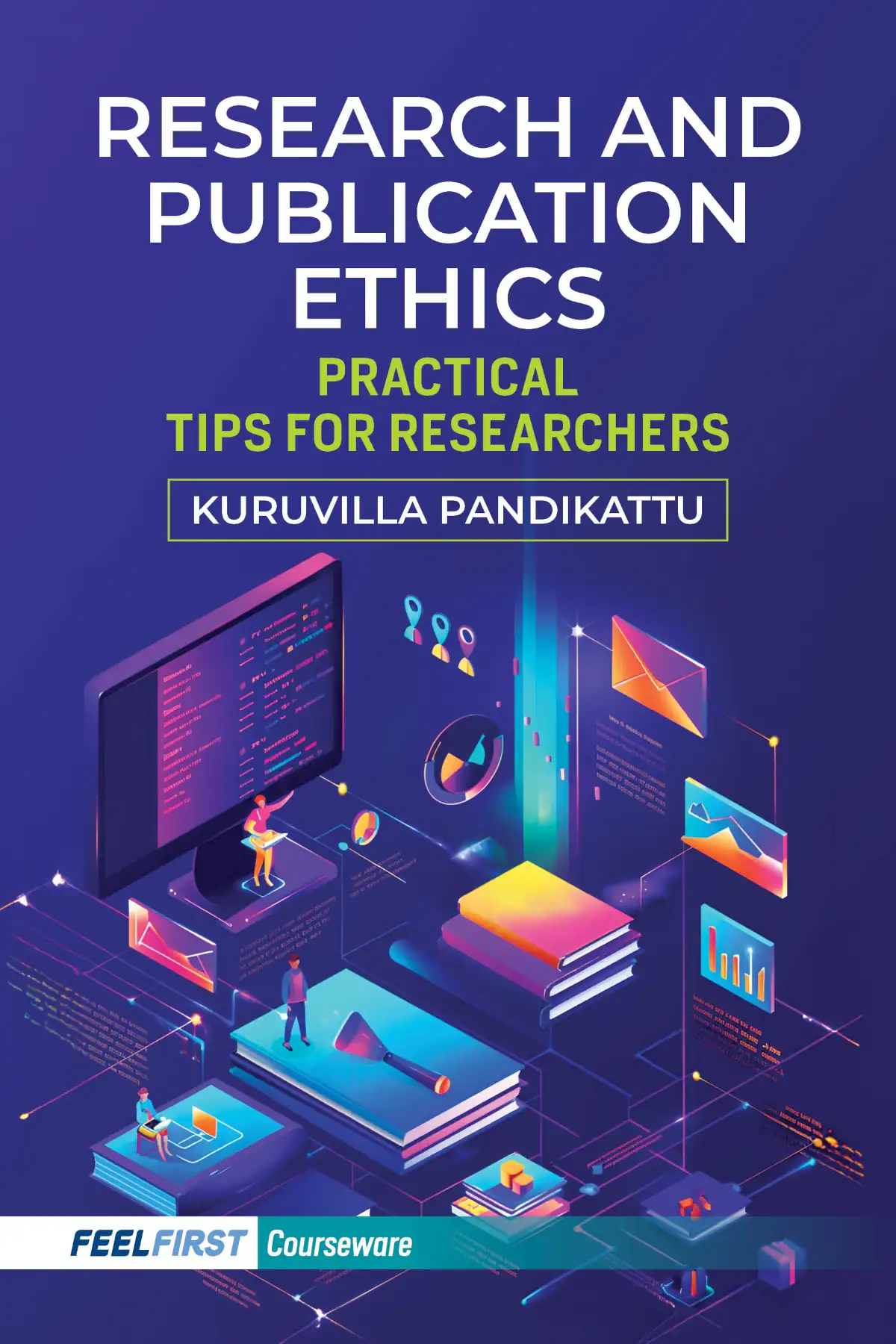
Research and Publication Ethics
Practical Tips for Researchers
Research and Publication Ethics offers a principled, practice-oriented guide to ethical scholarship, grounded in philosophy and attentive to the everyday realities of research and publishing.
Choose your option:
For institutional eBook access and prices, please contact us.
Research and Publication Ethics offers a principled, practice-oriented guide to ethical scholarship, grounded in philosophy and attentive to the everyday realities of research and publishing. Written for doctoral scholars, early-career researchers, faculty members, and research administrators, the book treats ethics not as a checklist for compliance but as a formative discipline rooted in truth, dignity, and trust. It advances a clear core claim: research is sacred work—an ethical covenant between investigators and participants, authors and readers, institutions and society.
Developed from a long-running course taught to FPM/Ph.D. scholars at XLRI, the book bears the imprint of classroom debate, case discussion, and reflective practice. It moves deliberately from first principles to daily procedures. The opening chapters clarify why philosophy matters to research, examining concepts of reality, evidence, logic, and value that underlie all scholarly methods. Subsequent chapters address scientific conduct and publication ethics in detail, including study design, data stewardship, honest reporting, authorship norms, peer review, conflicts of interest, reproducibility, and remedies for misconduct.
A distinctive feature of the book is its sustained engagement with the Indian research context. Ethical challenges arising from linguistic diversity, community-based research, unequal access to infrastructure, and intense publication pressures are addressed with practical guidance and proportionate safeguards. The text aligns closely with the University Grants Commission’s syllabus on Research and Publication Ethics and is structured as a teachable, examinable module, complete with case-based reasoning, procedural checklists, and classroom-ready units.
The later chapters extend ethics into practice through focused labs on plagiarism and integrity tools, open access publishing choices, databases and research metrics, discovery and documentation workflows, and responsible visibility. Throughout, the emphasis remains on clarity of claims, fairness in credit and evaluation, and the moral necessity of repair through correction, re-analysis, or retraction when errors occur. From foundational philosophy to hands-on ethical decision-making, the book aims to cultivate researchers who can think clearly, act justly, and sustain public trust in scholarship.
- Philosophy and Ethics
- Introduction
- What is Philosophy?
- What is Ethics?
- Main Ethical Theories
- Why Philosophy and Ethics Matter to Research
- Three Case Studies and Lessons Learned
- Scientific Integrity and Conduct
- Introduction
- Ethics with Respect to Science and Research
- Intellectual Honesty and Research Integrity
- Scientific Misconduct: Falsification, Fabrication and Plagiarism (FFP)
- Redundant Publications: Duplicate and Overlapping Work and ‘Salami Slicing’
- Selective Reporting and Misrepresentation of Data
- Digital Tools and (Limited) AI Assistance for Good Conduct
- Confidentiality, Privacy and Data Governance
- Three Case Studies and Lessons Learned
- Publication Ethics and Standards
- Introduction
- Publication Ethics: Definition, Introduction and Importance
- Standards and Guidelines: COPE and WAME (and Aligned Frameworks)
- Conflicts of Interest (COI)
- Publication Misconduct: Concept, Causes and Types
- Authorship and Contributorship
- Identification of Publication Misconduct
- Complaints and Appeals
- Predatory Publishers and Journals
- Where AI Touches Publication Ethics (Targeted, Not Pervasive)
- Reviewer and Editorial Confidentiality
- Three Case Studies and Lessons Learned
- Open Access and Author Rights
- Introduction
- What ‘Open Access’ (OA) Means and Why It Matters
- Copyright, Self-Archiving and SHERPA/RoMEO
- Choosing Target Journals (Ethically)
- Avoiding Problematic Venues
- Practical OA Workflows
- Three Case Studies and Lessons Learned
- Publication Misconduct Remedies
- Introduction
- Group Discussion Themes
- Conflicts of Interest (COI)
- Complaints and Appeals: Process Literacy
- Cases from India and Abroad
- Prevention Is Better Than Cure
- Three Case Studies and Lessons Learned
- Plagiarism and Integrity Tools
- Introduction
- Plagiarism/SIM-Check Software: What They Do (and Do Not Do)
- Open-Source and Free Utilities
- AI (Where It Helps and Where It Must Not)
- Workflow Playbooks
- Three Case Studies and Lessons Learned
- Research Metrics and Databases
- Introduction
- Indexing and Citation Databases: What to Use, When and Why
- Journal-Level Metrics (Use, Don’t Abuse)
- Author and Article Metrics
- Research Visibility, Ethically
- Evaluations and Policies
- Three Case Studies and Lessons Learned
- Ethics in Practice
- Introduction
- Lab Setup and Ground Rules
- India-Focused Case Set
- International Case Set
- Similarity Checking: Turnitin, Urkund/Ouriginal and iThenticate
- Beyond Text: Image and Data Forensics
- Complaints and Appeals Clinic
- Authorship and COI Negotiation Workshop
- Three Case Studies and Lessons Learned
- Discovery and Documentation Practice
- Introduction
- Orientation to Indexing vs. Citation Databases
- Hands-On Searching and Tracking
- Researcher Identity and Profiles
- Reference and Document Management
- Responsible Use of Metrics in Search Workflows
- Using AI in Literature Discovery
- Optional: AI-Assisted Discovery (With Safeguards)
- Three Case Studies and Lessons Learned
- Research and Publication Ethics: An Overview
- Introduction
- Why Research and Publication Ethics (RPE) Matter
- Conceptual Foundations
- Scientific Conduct
- Publication Ethics
- Open Access and Rights
- Publication Misconduct in Practice
- Tools, Databases and Metrics
- Practice and Professional Habits (Labs)
- Three Case Studies and Lessons Learned
Kuruvilla Pandikattu
Xavier School of Management
Kuruvilla Pandikattu is a Jesuit priest of the Dumka–Rajganj Province and Chair Professor (Emeritus) at XLRI Xavier School of Management, Jamshedpur. He also heads the Research & Publication Department in St. Xavier’s College in Dumka, Jharkhand. Professor Pandikattu’s academic journey has been marked by a sustained engagement with both the sciences and the humanities. In 1996, he began serving as Professor of Physics, Philosophy, and Religion at Jnana Deepa, Pune, where he contributed significantly to interdisciplinary scholarship.
Holding three master’s degrees and two doctorates in Philosophy and Theology, he has emerged as a leading voice in science–religion dialogue, philosophical anthropology, and transhumanism. His work reflects a consistent effort to build conversations across disciplines while remaining rooted in rigorous scholarship.
Over the course of his career, he has authored 37 books, edited 33 volumes, and published more than 240 scholarly articles. He has organised over 25 national and international conferences and has participated in more than 100 academic events across 25 countries. In addition, he has served on the editorial boards of five academic journals.
The following resources are available to help instructors in using this text in their classroom.
Lecture Slides
Chapter 1 (Lecture Slides | pptx) Download
PPT of Chapter 1 for instructorsChapter 2 (Lecture Slides | pptx) Download
PPT of Chapter 2 for instructorsChapter 3 (Lecture Slides | pptx) Download
PPT of Chapter 3 for instructorsChapter 4 (Lecture Slides | pptx) Download
PPT of Chapter 4 for instructorsChapter 5 (Lecture Slides | pptx) Download
PPT of Chapter 5 for instructorsChapter 6 (Lecture Slides | pptx) Download
PPT of Chapter 6 for instructorsChapter 7 (Lecture Slides | pptx) Download
PPT of Chapter 7 for instructorsChapter 8 (Lecture Slides | pptx) Download
PPT of Chapter 8 for instructorsChapter 9 (Lecture Slides | pptx) Download
PPT of Chapter 9 for instructorsChapter 10 (Lecture Slides | pptx) Download
PPT of Chapter 10 for instructorsRelated products
-
-
Sale!
Research Methodology
- Original price was: ₹699.00.₹500.00Current price is: ₹500.00.
- Select options This product has multiple variants. The options may be chosen on the product page
-
Sale!